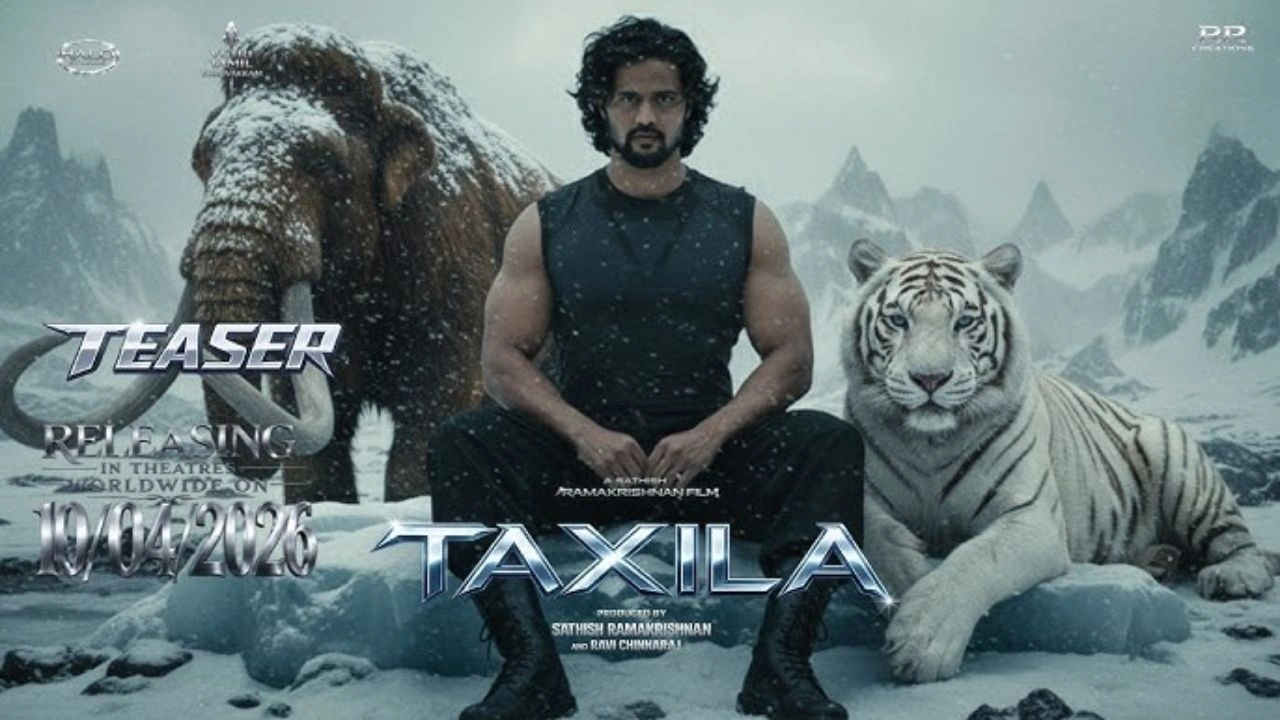
Taxila Movie: In a bold leap for Indian cinema, Taxila reimagines humanity’s future through a gripping science fiction narrative rooted in survival, legacy, and cosmic rebirth. Directed and written by Sathish Ramakrishnan, the film presents a unique premise—Earth’s destruction leading to the birth of a new civilization on a distant planet.
Set to release on April 10, 2026, in India, Taxila stands out as a high-concept Tamil sci-fi film that combines speculative science with emotional storytelling. Featuring Sathish Ramakrishnan, S.S. Raman, and Alagumuthu, the movie aims to push boundaries in a genre still emerging in Indian cinema.
A Groundbreaking Concept: When Earth Ends, Life Begins Again
The core premise of Taxila is both philosophically profound and scientifically intriguing:
After Earth is obliterated, fragments of its existence—genetic material, knowledge, and encoded memories—travel across the universe and seed a new world called Taxila.
Concept Breakdown
| Element | Meaning in the Film Context |
| Earth’s Destruction | End of human civilization |
| Encoded Legacy | Preservation of human knowledge and DNA |
| Interstellar Travel | Transmission of life across galaxies |
| Planet Taxila | A barren world transformed into a new cradle of humanity |
This idea blends science fiction with existential philosophy, asking one fundamental question:
Can humanity truly survive its own extinction?
Read Also: Hokum Movie 2026: Haunted Irish Inn Horror
Story Expectations: A Tale of Rebirth and Discovery
While full plot details remain under wraps, Taxila is expected to follow a multi-layered narrative structure combining survival, discovery, and identity.
Possible Narrative Structure
| Story Phase | Description |
| Prologue | The destruction of Earth |
| Journey | Transmission of life and data across space |
| Awakening | The birth of life on Taxila |
| Conflict | Challenges faced by the new civilization |
| Resolution | Humanity’s evolution and new identity |
The film may explore both macro-level events (cosmic scale) and micro-level human emotions, creating a balanced storytelling approach.
Direction & Vision: Sathish Ramakrishnan’s Ambitious Leap
Sathish Ramakrishnan, serving as both director and writer, takes a bold step into the sci-fi genre.
Key Strengths of His Vision
- Original storytelling concept rarely seen in Indian cinema
- Focus on philosophical depth alongside visual spectacle
- Integration of science, emotion, and narrative complexity
- Commitment to innovative filmmaking
His dual role ensures a cohesive narrative, allowing the film to maintain a consistent tone and vision.
Star Cast and Character Dynamics
Main Cast Overview
| Actor Name | Role Type | Contribution to Film |
| Sathish Ramakrishnan | Lead protagonist | Vision-driven performance, emotional depth |
| S.S. Raman | Supporting character | Adds narrative complexity |
| Alagumuthu | Supporting/parallel role | Enhances realism and character diversity |
Performance Expectations
Given the film’s concept, performances are expected to be:
- Emotionally grounded despite the sci-fi setting
- Focused on human survival instincts
- Reflective of psychological and existential struggles
Scientific Themes and Concepts Explained
One of the most fascinating aspects of Taxila is its use of real-world scientific ideas.
1. Panspermia Theory
The film’s premise aligns closely with the panspermia hypothesis, which suggests that life can spread across the universe via:
- Asteroids
- Comets
- Cosmic dust
This gives the film a strong scientific foundation, making it more believable.
2. Genetic Memory and Data Encoding
The concept of encoded legacy could involve:
- DNA as a storage medium
- Digital preservation of human knowledge
- Artificial intelligence systems guiding new life
3. Terraforming and Planetary Evolution
The transformation of Taxila from a barren world into a habitable planet may explore:
- Atmospheric changes
- Biological adaptation
- Ecosystem development
Themes That Define Taxila
1. Survival of Humanity
At its core, the film is about human resilience and survival beyond extinction.
2. Legacy and Memory
The idea that humanity’s essence can outlive its physical existence is a powerful theme.
3. Rebirth and Evolution
Taxila explores how life can:
- Start anew
- Adapt to new environments
- Evolve beyond its origins
4. Ethical Questions About Creation
The film may raise critical questions:
- Should humanity attempt to recreate itself?
- What responsibilities come with creating life?
Technical Aspects: Bringing a Sci-Fi World to Life
Technical Breakdown
| Aspect | Expected Highlights |
| Visual Effects | Space sequences, planetary visuals |
| Cinematography | Expansive cosmic imagery |
| Background Score | Atmospheric and immersive |
| Production Design | Futuristic yet grounded environments |
Sci-fi films rely heavily on visual storytelling, and Taxila is expected to deliver a visually rich experience.
Comparison with Global Sci-Fi Films
| Feature | Global Sci-Fi Films | Taxila’s Approach |
| Scale | Large budgets | Concept-driven storytelling |
| Themes | Technology & space | Philosophy + survival |
| Emotional Depth | Variable | Strong human focus |
| Cultural Perspective | Western-centric | Indian philosophical lens |
This unique perspective could help Taxila stand out internationally.
Audience Appeal and Market Potential
Target Audience
- Sci-fi enthusiasts
- Youth and tech-savvy viewers
- Fans of philosophical storytelling
- Pan-Indian audiences
Market Strengths
- Unique concept in Indian cinema
- Universal themes of survival and rebirth
- Strong OTT potential
OTT Potential and Global Reach
Given its universal themes, Taxila is well-suited for streaming platforms.
OTT Advantages
- Global accessibility
- Multi-language subtitles
- High rewatch value
The film could gain international recognition, especially among sci-fi audiences.
Strengths and Challenges
Strengths
- Original and ambitious concept
- Strong philosophical depth
- Potential for visual innovation
- Scientific relevance
Challenges
- High expectations for visual effects
- Complexity of narrative execution
Taxila Movie Details (Quick Overview)
| Category | Details |
| Movie Title | Taxila |
| Director | Sathish Ramakrishnan |
| Writer | Sathish Ramakrishnan |
| Language | Tamil |
| Country | India |
| Genre | Sci-Fi |
| Release Date | April 10, 2026 |
| Main Cast | Sathish Ramakrishnan, S.S. Raman, Alagumuthu |
Read Also: Toy Story 5 Movie 2026: A New Adventure Animation
Why Taxila Could Be a Landmark in Indian Sci-Fi
Indian cinema has historically produced limited sci-fi content. Taxila represents:
- A bold step into high-concept storytelling
- Expansion of genre diversity
- A shift toward intellectual and philosophical narratives
If successful, it could inspire a new wave of Indian sci-fi films.
Official Trailer – Taxila movie
Conclusion: A Bold Vision of Humanity’s Future
Taxila is more than just a movie—it is a thought experiment about humanity’s place in the universe.
With its compelling concept, strong thematic foundation, and ambitious execution, the film has the potential to:
- Redefine Indian sci-fi cinema
- Engage audiences intellectually and emotionally
- Deliver a memorable cinematic experience
For viewers seeking a film that combines science, philosophy, and storytelling, Taxila is a must-watch in 2026.